
Senate Bill (SB) 1000 (Lara, Statutes of 2018, Chapter 368) requires the California Energy Commission, as part of the development of the Clean Transportation Program Investment Plan, to assess whether electric vehicle (EV) charging station infrastructure is disproportionately deployed by population density, geographical area, or population income level.
The third SB 1000 Assessment analyzes barriers to installing an EV home charger, estimates the number and location of EVs with and without home charging access, and estimates the number and location of EVs lacking both home charging access and near-home public charging.
Results are based off model estimates from the SB 1000 assessment. Read the 2026 SB 1000 Staff Report for a full description of data sources and methodology.
For additional information, visit Electric Vehicle Infrastructure Deployment Assessment – SB 1000.
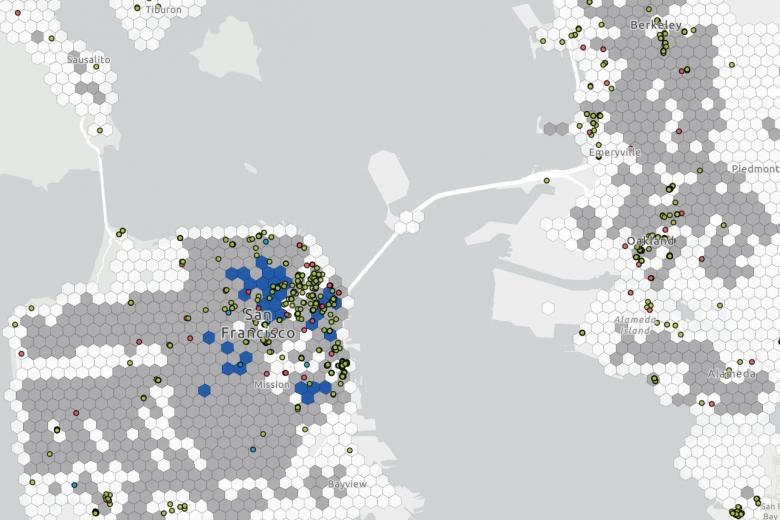
Near-Home Charging Demand From EVs Without Home Charging
Map to evaluate concentrations of electric vehicles (EVs) likely without home charging and demand for near-home public charging.
Download Data
Overview
The map displays quarter-mile hexagons that show concentrations of public charging market demand from electric vehicles (EVs) estimated to lack home charging. Additional layers can be toggled on and off to view locations of low-income or disadvantaged communities, urban or rural areas, and federally recognized tribal lands.*
Results are based off model estimates from the SB 1000 assessment. See the 2026 SB 1000 Staff Report for a full description of data sources and methodology.
While EVs without home charging may access charging in a variety of ways, this map includes layers that show market demand for two types of near-home public charging:
- Nearby charging: Public Level 2 or direct-current (DC) fast charging within two miles of households that can be used for short-duration charging.
- Walking-distance charging: Public Level 2 charging within an eighth of a mile of households that can be used for long-duration charging such as overnight charging
While the above scenarios are used for this assessment, staff note that the availability of near-home public charging is subject to many variables, potentially including existing land use, zoning, and local permitting.
Two utilization options for public charging capacity are available:
- Under the high utilization option, a public Level 2 charger that is located within an eighth of a mile of households (walking distance) can adequately serve 5 EVs without home charging (3 EVs overnight on separate nights and 2 EVs during the day). A public DC fast charger that is located within two miles of households (within the neighborhood) can adequately serve 30 EVs without home charging during the day. Public DC fast chargers would not be used for long-duration charging, such as overnight charging.
- Under the low utilization option, a public Level 2 charger that is located within an eighth of a mile of households can adequately serve 3 EVs without home charging (2 EVs overnight on separate nights and 1 EV during the day). A public DC fast charger that is located within two miles of households can adequately serve 20 EVs without home charging during the day. Public DC fast chargers would not be used for long-duration charging, such as overnight charging.
* The CEC purchased property and parcel boundary data from CoreLogic, Incorporated that includes information on parcel location, ownership, tax assessment, and property characteristics. This data was used to estimate home charging barriers and likeliness of not having a home charger. In general, tribal lands are exempt from local and state taxation, including property taxes. Therefore, property data to assess barriers to having a home charger may be sparse in federally recognized tribal lands.
Navigate Layers, Legends, and Basemaps
The default map layer shows market demand for public near-home charging from EVs in 2024. EVs contribute to market demand if they are estimated to lack home charging.
- To view additional layers, click on the Layers icon, which can be found in the left sidebar menu. All layers can be turned on and off. To turn a layer on or off, click on the eye icon to the right of the layer name.
- To view concentrations of EVs in a 100% EV future, turn off the 2024 EVs Without Home Charging layer and turn on the EVs in a 100% EV Future Without Home Charging layer.
- To view market demand for public charging, turn off the default layer and turn on different market demand layers, including Public Nearby (2-miles) Charging Demand From EVs without Home Charging and Public Walking Distance (1/8th mile) Level 2 Charging Demand From EVs Without Home Charging.
- Zoom into the map to view public charging station locations as of March 2025 and click on the stations to view additional charger information.
- Turn on the Low-income or Disadvantaged Community, Urban or Rural, or Federally Recognized Tribal Lands layer to see how these communities overlap with model estimates of market demand and EVs without home charging.
- Click on the Legend icon, which can be found in the left sidebar menu, to see legends for the layers turned on.
- Click on the Basemap icon to change the map backdrop.
Identify Potential Sites
- If the goal is to see market demand for public nearby charging within low-income or disadvantaged community areas, turn on the Low-income or Disadvantaged Community layer and Public Nearby (2-miles) Charging Demand From EVs Without Home Charging (high or low utilization option) layer.
- Alternatively, if the goal is to see market demand for public walking-distance charging within an urban or rural area, turn on the Urban or Rural layer and Public Walking-Distance (1/8th mile) Level 2 Charging Demand From EVs Without Home Charging (high or low utilization option) layer.
Click on the magnifying glass on the bottom right of the map, type in an address, and press enter to see if the site is within the layers of interest.
100% EV Future – A hypothetical scenario where all vehicles registered in 2024 are electric.
Charger – The system within an electric vehicle supply equipment (EVSE, defined as a device with one or more charging ports and connectors for charging EVs) that charges one EV. A charger may have multiple connectors, but it can provide power to charge only one EV through one connector at a time. Also referred to as a charging port.
Charging Station – A physical address where one or more chargers are available for use. This is the same usage as for “gas station.” A charging station can be public, shared private, or private.
Direct Current Fast Charging – Electric vehicle charging anywhere from 200 to 1,000 volts using direct current.
Disadvantaged Communities – Census tracts that score within the top 25th percentile of the Office of Environmental Health Hazards Assessment’s California Communities Environmental Health Screening Tool (CalEnviroScreen) 4.0 scores, as well as areas of high pollution and low population, such as ports.
Electric Vehicle (EV) – A broad category that includes all vehicles that can be fully powered by electricity or an electric motor.
Federally Recognized Tribal Lands – Lands under control of federally recognized tribes, including American Indian/Alaska Native/Native Hawaiian entities for which the Census Bureau publishes data, which consist of federally recognized American Indian Reservations and Off-Reservation Trust Lands (ORTL).
High Utilization Option – A public Level 2 charger that is located within an eighth of a mile of households (walking distance) can adequately serve 5 EVs without home charging - 3 EVs overnight on separate nights and 2 EVs during the day. A public DC fast charger that is located within 2 miles of households (within the neighborhood) can adequately serve 30 EVs without home charging, all during the day since DC fast chargers would not be used for long-duration charging, such as overnight charging.
Level 2 Charging – Electric vehicle charging at 240 volts using alternating current.
Low-income Communities – Census tracts with median household incomes at or below 80 percent of the statewide median income or with median household incomes at or below the threshold designated as low income by the Department of Housing and Community Development’s list of state income limits adopted pursuant to Section 50093 of the California Health and Safety Code.
Low Utilization Option – A public Level 2 charger that is located within an eighth of a mile of households (walking distance) can adequately serve 3 EVs without home charging - 2 EVs overnight on separate nights and 1 EV during the day. A public DC fast charger that is located within 2 miles of households (within the neighborhood) can adequately serve 20 EVs without home charging during the day.
Multifamily home (MFH) – A classification of housing where separate housing units for residential inhabitants are contained within one building or several buildings within one complex. Units can be next to each other (side-by-side units) or stacked on top of each other (top and bottom units). A common form is an apartment building. Many intentional communities incorporate multifamily residences, such as in cohousing projects.
Rural – Census tracts where less than 10 percent of the tract’s land area is designated as urban by the Census Bureau using the 2020 urbanized area criteria.
Rural Center – Contiguous urban census tracts with a population of less than 50,0000. Urban census tracts are tracts where at least 10 percent of the tract’s land area is designated as urban by the Census Bureau using the 2020 urbanized area criteria.
Single-family home (SFH) – Units that are separated by a ground-to-roof wall, have separate heating system, individual meters for public utilities, and no units located above or below. May include fully detached, semi-detached, row houses, duplexes, and townhomes.
Urban – Contiguous urban census tracts with a population of 50,000 or greater. Urban census tracts are tracts where at least 10 percent of the tract’s land area is designated as urban by the Census Bureau using the 2020 urbanized area criteria.
Map last updated: February 4, 2026
Data Inputs and Sources
Market demand for near-home public charging station infrastructure from electric vehicles (EVs) estimated to lack home charging and sufficient public charging in 2024, and concentrations of EVs estimated to lack home charging are model estimates from the Access to Public Near-Home Charging Among Electric Vehicles Without Home Charging: Senate Bill 1000 Third California Electric Vehicle Infrastructure Deployment Assessment, available on the Electric Vehicle Infrastructure Deployment Assessment – SB 1000 Web page. Model inputs and sources include:
- Housing attributes, including housing type, year built, and tenure, as well are parking information are from CoreLogic, Incorporated. The CEC purchased property and parcel boundary data from CoreLogic, Incorporated that includes information on parcel location, ownership, tax assessment, and property characteristics. CoreLogic, Incorporated and/or its subsidiaries retain all ownership rights in the data, which end user agree is proprietary to CoreLogic. All Rights Reserved. The data is provided AS IS; end user assumes all risk on any use or reliance on the data. CEC staff implemented quality control and standardization to the CoreLogic data before imputing housing attributes into the model to estimate barriers to home charging.
- Panel size estimates for single-family homes are from the University of California, Los Angeles Center for Sustainable Communities.
- Home charging access estimates were applied using survey results from the National Renewable Energy Laboratory and University of California, Davis.
- Vehicle assignment estimates were calculated using vehicle registration data from the Zero Emission Vehicle and Infrastructure Dashboard and vehicle counts by housing attributes from Public Use Microdata Sample.
- Public charging station locations are from the U.S. Department of Energy’s Alternative Fuels Data Center and PlugShare as of March 13, 2025.
Low-income or Disadvantaged Community as well as Federally Recognized Tribal Lands designations are from the California Environmental Protection Agency (CalEPA) under Senate Bill (SB) 535 and the California Air Resources Board under Assembly Bill (AB) 1550.
Urban or Rural designations are from the SB 1000 assessment using data from the U.S. Census Bureau.
Citing: Hoang, Tiffany, Adam Davis. 2026. Access to Public Near-Home Charging Among Electric Vehicles Without Home Charging: Senate Bill 1000 Third California Electric Vehicle Infrastructure Deployment Assessment. California Energy Commission.