
General Information on ADUs
Accessory dwelling units (ADUs) are secondary dwelling units on residential lots. Also known as granny units, in-law units, tiny houses, or secondary houses, they can be used to house family and visitors, or as rental properties. Like all other residential structures in California, ADUs are subject to the Energy Code. According to Part 2 of the California Building Code, an ADU is an attached or detached residential dwelling unit that provides complete independent living facilities for one or more persons and is located on a lot with a proposed or existing primary residence. ADUs shall include permanent provisions for living, sleeping, eating, cooking, and sanitation on the same parcel as the single-family or multifamily dwelling.
As defined by the Energy Code, Section 100.1 – PDF, a junior accessory dwelling unit (JADU) is a dwelling unit that is no more than 500 square foot in size and is contained entirely within a newly constructed or existing single-family building. A JADU includes a kitchen, a separate entrance from the main entrance to the building, and an interior entry to the main living area. A JADU may include sperate sanitation facilities or may share sanitation facilities within the newly constructed or existing single-family building.
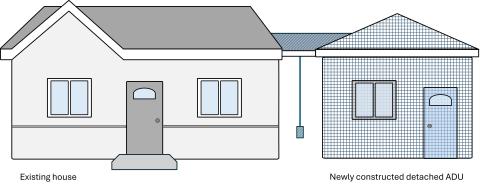
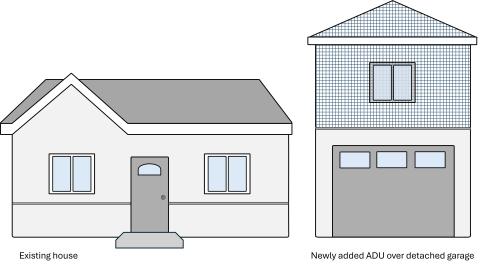
For compliance with the Energy Code, an ADU is considered a newly constructed building if it is a new, detached structure. According to the Energy Code Section 100.1 – PDF, a newly constructed building is a building that has never been used or occupied for any purpose. This means that a newly constructed detached ADU must comply with the Energy Code requirements for a new single-family newly constructed building. Similarly, JADUs must also comply with the Energy Code requirements when they are built as a part of a newly constructed building.
Example of newly constructed building

Image above represents new conditioned floor area and volume.
- Newly constructed building with optional breeze way
Some ADUs are treated as additions for compliance with the Energy Code. According to the Energy Code Section 100.1 – PDF, an addition is any change to a building that increases conditioned floor area and conditioned volume.
This means that attached ADUs and conversions of existing unconditioned spaces (like garages or storage areas) into conditioned spaces are considered additions. There are two common types of ADU additions:
- Attached ADUs – These are dwelling units that share a common wall, floor, or ceiling with another dwelling unit.
- Conversions of Unconditioned Space – This includes ADUs converted from unconditioned to directly or indirectly conditioned space, whether attached or detached from the existing building.
Both types of additions must comply with the Energy Code requirements in Section 150.2(a) - PDF.
Additionally, Junior ADUs (JADUs) may be subject to the Energy Code requirements depending on the scope of work and whether they are part of an addition to an existing building.
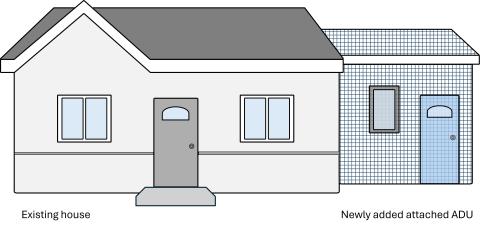
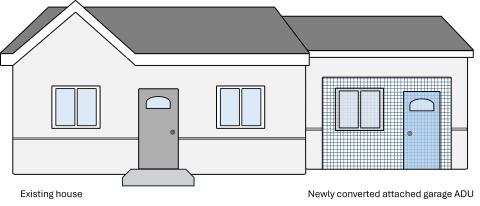
Example of additions

Image above represents new conditioned floor area and volume.
- Attached addition of new conditioned floor area and volume
- Attached garage conversion to conditioned floor area and volume
- Detached garage conversion to conditioned floor area and volume
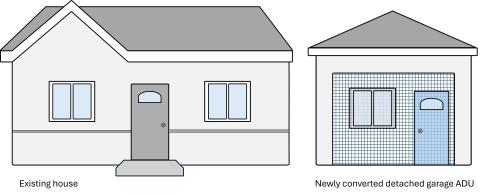
- Detached garage addition of new conditioned floor area and volume
Converting existing conditioned floor area (such as a conditioned basement or pool house) into an ADU or JADU is considered an alteration. Altering a building component covered by the Energy Code triggers the alteration requirements in Section 150.2(b) - PDF that must be met. According to the Energy Code Section 100.1 – PDF, an alteration is any change to a building’s water-heating system, space-conditioning, lighting system, electrical power distribution system, or envelope that is not an addition.
Examples of alterations
- Attached conversion of conditioned floor area
- An existing conditioned space that is physically connected to the existing house – such as a finished room, conditioned basement, or enclosed living area – that is repurposed into an ADU or JADU. This project is considered an alteration because it does not increase the total condition floor area or volume but alters an existing building component.
- Detached conversion of conditioned floor area
- An existing conditioned detached structure– such as a conditioned pool house, studio, or guest house– that is repurposed into an ADU or JADU. This project is considered an alteration because it does not increase the total condition floor area or volume but alters an existing building component.
No. This type of project is considered an alteration. Energy Code requirements may be triggered if altering a component which is covered by the Energy Code. Some examples of alterations that are covered by the Energy Code are newly installed water heaters or mini-split HVAC systems, lighting upgrades, changes to the building envelope, etc.
Yes. Factory-built housing is a factory-constructed version of a site-built residential building that is manufactured and then transported to its permanent installation location. Factory-built homes must comply with Title 24, including the Energy Code (Title 24, Part 6).
In contrast, a manufactured home is a structure, transportable in one or more sections, which in the traveling mode is 8 body feet or more in width or 40 body feet or more in length or which when erected on-site is 320 or more square foot, and which is built on a permanent chassis and designed to be used as a dwelling with or without a permanent foundation when connected to the required utilities, and includes the plumbing, heating, air-conditioning, and electrical systems contained in the structure. Manufactured homes have U.S. Department of Housing and Urban (HUD label) certification on them indicating they have met the applicable federal standards. Manufactured homes must meet the Title 25 regulations and are not subject to the Energy Code.
Yes. According to Section 100.0 – PDF of the 2025 Energy Code, if the building was not permitted prior and the building permit application is submitted now, then the ADU must meet the applicable Energy Code requirements. The building department should determine how to demonstrate compliance and whether the ADU must comply as a newly constructed building or as an addition.
See the CBECC Frequently Asked Questions (FAQs) for more information on modeling ADUs in the compliance software.
Solar Photovoltaic (PV) System Requirements for ADUs
Yes. New solar PV modules can be added to an existing solar PV system, not necessarily on the newly constructed detached ADU, to meet the Section 150.1(c)14 - PDF requirements of the 2025 Energy Code. The new solar PV modules must be a part of the ADU’s permit application, sized in accordance with the Energy Code, and comply with other applicable parts of the building code.
Yes. The 2025 Energy Code does not specify where new solar PV modules must be installed. Adding new solar PV modules to an existing solar PV system will satisfy the solar PV requirements in Section 150.1(c)14 - PDF if the added solar PV modules are on the same residential lot as the ADU and expansion of the solar PV system is allowed by the load-serving entity. The Energy Code does not specify whether the solar PV modules must serve the dwelling unit meter or the main house meter. Any added solar PV modules must also comply with other parts of the building code as applicable.
No. Newly constructed detached ADUs must have a newly installed solar PV to meet the prescriptive requirements of Section 150.1(c)14 – PDF unless an exception applies. For more information on solar PV requirements, see the 2025 Single-family Solar PV FAQs.
No. Per Section 110.10(a)1 solar ready applies to new single-family homes located in subdivisions of ten or more. Therefore, solar ready is not applicable to a newly constructed ADU on an existing lot.
No, since attached ADUs are considered additions, solar PV is not required.
Battery Energy Storage System (BESS) Ready Requirements for ADUs
Yes. A newly constructed ADU must meet the battery energy storage system ready requirements per Section 150.0(s). If the electric service for the ADU is 125 amps or less, the BESS-ready requirements will not apply as indicated in Section 150.0(s) - PDF. Please visit the battery energy storage system ready FAQs for more information.
Yes. A 200-amp panel could meet the requirements if the busbar rating is 225 amps per Section 150.0(s)3 - PDF, and it is clearly marked on the panel. The busbar rating is usually found on the panel's interior metal surface or on the panel door label, indicating the maximum current capacity the busbar can safely carry. However, if there is no specific busbar rating on the panel, the 200-amp panel will not meet the requirements since the busbar rating will be the same as the panel rating. Panels must also meet the applicable requirements in the California Electrical Code.
No. The subpanel to the new ADU from the main panel could meet Section 150.0(s)1B – PDF, if the main panel has the 225-amp busbar rating.
Yes. According to Section 150.0(s)1A - PDF, BESS-ready interconnection equipment must have 60 amps of backup capacity and a minimum of four BESS-supplied branch circuits. Various configurations of panels and subpanels can meet the BESS-ready requirements of Section 150.0(s) – PDF. See the 2025 Single-family BESS-ready FAQs for more information.
Yes. Per the exception to Section 150.0(s) - PDF, if a newly built home’s battery energy storage system includes all necessary wiring and electrical components to support a fully operational system, it will satisfy the mandatory requirements of Section 150.0(s) - PDF.
Water Heating and Electric-ready Requirements for ADUs
Yes. Newly constructed detached ADUs must meet the electric-ready requirements in Section 150.0(n) – PDF and Section 150.0(t-v) - PDF when installing gas water heating, space heating, cooktop, or clothes dryer appliances. For more information on electric-ready requirements, see the 2022 Single-family Electric Ready FAQs.
Yes. Exception 1 to Section 150.1(c)8 – PDF allows a newly constructed dwelling unit with 500 square foot or less to install an electric water heater with point-of-use distribution per Reference Residential Appendix RA4.4.5 - PDF.
No. Under the prescriptive approach, Exception 1 to Section 150.1(c)8 - PDF for newly constructed dwelling units with 500 square foot or less specifies an instantaneous electric water heater with point-of-use distribution may be used when the requirements of the Reference Residential Appendix RA4.4.5 are met. Under the performance approach, multiple water heaters may be modeled. However, the energy budget of the designed building will be compared to the energy budget of the prescriptive standard design.
No. Per the prescriptive requirement in Section 150.2(a)1Diii - PDF, when an additional water heater is installed to serve a single-family addition that is 500 square foot or less, an electric water heater with point-of-use distribution as specified in Reference Residential Appendix RA4.4.5 may be used. Under the performance approach, multiple water heaters may be modeled. However, the energy budget of the designed building will be compared to the energy budget of the prescriptive standard design.
Yes. According to Section 150.2(a)1Diii - PDF, if the ADU addition is 500 square foot or less, an electric water heater may be used prescriptively, with point-use-distribution per Reference Residential Appendix RA4.4.5 - PDF.
Yes. An electric water heater may serve more than one fixture when the requirements of Reference Residential Appendix RA4.4.5 - PDF are met. The point-of-use water heater pipe runs must meet pipe diameter and length requirements specified in Table 4.4.5 – PDF and take the most direct path. The manufacturer’s installation specifications for the number of fixtures served should be followed.
Yes. A 10-foot pipe run can meet Reference Residential Appendix RA4.4.5 – PDF pipe length requirements depending on the pipe diameter. For example, Reference Residential Appendix RA4.4.5 allows up to 15 feet of pipe length for 3/8-inch pipe or 10 feet of 1/2-inch pipe. If a combination of pipe diameters is used in a single run, then one-half of the allowed length of each size is the maximum installed permissible length.
Heating, Ventilation, and Air Conditioning (HVAC) Requirements for ADUs
No. All newly constructed dwelling units must meet the mandatory ventilation requirements in Section 150.0(o) – PDF for indoor air quality no matter the size of the ADU.
Possibly. Ventilation requirements in additions and alterations, including junior ADUs, may be required by the California Mechanical Code. In those cases, the California Mechanical Code may point to the new construction Energy Code requirements in Section 150.0(o). For questions, contact the California Housing and Community Development (HCD).
Yes. The Single-Family ACM Manual Section 2.4 - PDF lists heat pump equipment types under Table 8 - PDF. All systems must meet the mandatory space-conditioning equipment requirements in Section 110.2 - PDF, Section 150.0(h) - PDF and other applicable sections in 150.0, 150.1, and 150.2 depending on if the project is new construction or an addition.
Yes. Depending on the scope of the project, mini-splits and multi-splits may require Energy Code Compliance (ECC) rater field verification and diagnostic testing. The mini-split or multi-split system must meet all applicable mandatory and prescriptive requirements in Section 150.0 - PDF, Section 150.1 - PDF, and Section 150.2 - PDF, as well as any performance credit requirements per Section 150.1(b)2 - PDF modeled with the Energy Code compliance software. The following list includes common ECC-rater field verifications and diagnostic testing:
- Duct leakage testing (ducted systems)
- Fan efficacy watts per cubic feet per minute (ducted systems)
- Verified SEER2
- Verified HSPF2
- Verified heat pump rated heating capacity
- Minimum airflow
- Refrigerant charge in all climate zones per Section 150.1(c)7A - PDF
For a complete list of ECC-rater field verification and diagnostic testing see Reference Appendix Table RA2-1 – PDF.
No. The California Mechanical Code does not allow return air from an existing forced-air-system to be discharged into another dwelling unit through the heating or cooling system. Therefore, the existing ducted furnace may not serve the existing home and the proposed ADU.
Yes. Vented range hoods installed in ADUs must have their certification, airflow, and sone rating verified by an ECC rater per Section 150.2(a)1Cii, 150.0(o)1G, and 150.0(o)2B.
Envelope and Lighting Requirements for ADUs
Yes. Per Section 150.2(a)1Bv – PDF the QII prescriptive requirements of Section 150.1(c)1E – PDF do not apply to ADU additions that are 700 square foot or less. However, if QII was modeled for a compliance credit, then an ECC rater must verify the air barrier and the insulation installation meet the requirements of Reference Residential Appendix RA3.5 - PDF. For more information on air barriers see the Air Sealing fact sheet.
Yes. Per Section 150.2(a)1A-B - PDF additions must meet the prescriptive requirements in Section 150.1(c)11 - PDF for roofing products with steep-sloped roofs in climate zones 10-15, and low-sloped roofs in climate zones 13 and 15. Exception 1 to Section 150.2(a) - PDF applies to additions that are 300 square foot or less. For more information see the Single-Family Cool Roof brochure.
Yes. If the proposed ADU is considered an addition in the Energy Code, then the existing 2x6 walls can be insulated with R-21 cavity insulation per Section 150.2(a)1Ai and (Section 150.2(a)1Bvi) for prescriptive compliance. Continuous insulation is not required for these walls.
No. Existing walls in newly conditioned spaces are considered “new” for the purpose of the Energy Code since the walls enclose the building envelope around newly conditioned space. ECC-verification of existing conditions is only applicable to “altered” components per Section 150.2(b)2B.
No. All newly constructed dwelling units, including additions, must meet the mandatory lighting requirements in Section 150.0(k) - PDF, regardless of the square footage. If the ADU is an alteration (e.g., conversion from pre-existing conditioned space), then they must meet requirements under Section 150.2(b)1K - PDF.
More Resources for ADUs
ADU training presentation and materials
- See the Blueprint for more information, including articles and frequently asked questions about the 2025 Energy Code.