
Updated July 2026
Many factors affect gasoline prices, including crude oil cost, refinery operation costs, distribution costs, marketing costs, and profits.
Filling up the tank in California costs more on average than other parts of the United States because of 1) the isolated nature of the state’s transportation fuels market, 2) a special gasoline blend that reduces air pollution, 3) environmental program fees, and 4) local, state, and federal taxes. See a breakdown of California costs here.
An Isolated Market
California’s transportation fuels market is isolated, meaning that gasoline purchased in California is either refined in the state or shipped by marine vessel from domestic or foreign sources.
There are no pipelines bringing fuel into the state. Pipelines connect the state’s refining centers to distribution terminals in Nevada and Arizona, but they only flow east and send gasoline and other transportation fuels to these states.
Imported crude and refined oil can come from domestic sources, but the majority comes from Asia, Africa, South America, and the Middle East. Overseas supply can take three weeks to arrive at California marine terminals, isolating California oil refineries and fuel distribution centers by time and distance. As a result, price spikes triggered by unplanned refinery outages or international supply shocks may last longer for Californians because resupply time is longer.
Imported gasoline and blending components accounted for 19 percent of supply in 2025. Supplies of gasoline and diesel fuel from outside the state are routinely needed to balance supply with demand.
Taxes and Fees
Taxes on California gasoline remain relatively stable and are reinvested in California to fund road repairs, highway maintenance, bridge safety, public transit, bicycle and pedestrian projects. Environmental program fees are invested in community clean air initiatives and climate programs and innovation, all of which have displaced massive amounts of the emissions.
Disruption to Gas Prices in California
Changes in gasoline prices in California are primarily driven by the cost of global crude oil. Gasoline prices are highly sensitive, so any shift in supply and demand changes what you pay at the pump. For example, following Russia’s invasion of Ukraine in February 2022, crude oil prices spiked, triggering global rises in gas prices. Similarly, in March 2026 when the United States initiated war in Iran, the cost of crude soared as did prices at the pump around the globe.
Within California, prices can also be affected during significant unplanned refinery outages. For example, following a fire at a northern California refinery in February 2025, prices at the pump rose about 42 cents in the northern region until imports could replace lost supply within a couple months.
Recent Legislation
After the spikes in California gas prices in 2022 and 2023, the Legislature passed two special session laws known as Senate Bill X 1-2 (in 2023) and Assembly Bill X 2-1 (in 2024).
SB X1-2 and AB X2-1 granted the California Energy Commission (CEC) an array of tools to stabilize petroleum prices and supply. To date, the CEC has implemented tools that give us significantly more visibility into California refinery operations, helping us better understand the complexities of the petroleum industry, support long-term planning efforts, increase industry accountability, and protect consumers. Also, the Division of Petroleum Market Oversight—an independent watchdog agency within the CEC—was created in 2023 by SB X1-2 to protect consumers from price spikes.
The laws are delivering results. In 2024, the annual average price of a gallon of gasoline was 20 cents lower than in 2023 and 70 cents lower compared to 2022, adjusted for inflation. This equated to an avoided cost to Californians of about $2.5 billion compared to 2023 and $9.3 billion compared to 2022. Retail prices in 2025 continued to remain lower and exhibited a narrower range than the previous three years, indicating fewer price spikes and a more balanced supply-demand environment.

California Consumption
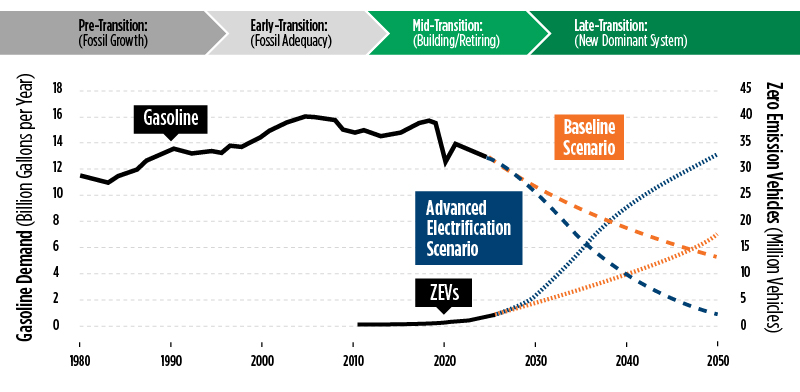
Like many governments around the world, California has begun to transition away from the use of fossil-based transportation fuels. Efforts to incentivize zero-emission vehicles and build out clean fuel infrastructure in California are working: demand for oil is falling.
As of 2025, Californians consume about 36 million gallons per day. In-state demand is declining 0.5 to 2 percent per year primarily due to increased electric vehicle sales.
Total consumption is projected to drop to 21 million gallons or lower per day by 2040, according to the CEC’s 2024 Integrated Energy Policy Report.
California's Oil Refineries
As of January 2026, California has 12 oil refineries, which are located in the Bay Area, Central Valley, and Los Angeles. Together, these refineries process about 1.5 million barrels per day of crude oil. Of the 12 oil refineries, eight major refineries produce transportation fuels that meet California’s specific environmental standards for formulated gasoline, and four smaller ones produce other fuels. The major refineries also provide most of Nevada and nearly half of Arizona’s transportation fuels.
Valero Energy’s Benicia refinery intends to stop refining operations by the end of April 2026, which will leave only seven refineries that produce gasoline.
In 2025, 81 percent of the gasoline consumed in California came from in-state refineries. As a result, significant unplanned refinery outages contribute to increases in the price at the pump.
Sources of Crude Oil
Most of the crude oil that California’s refineries process comes from out of the state. See the latest breakdown of annual crude oil supply sources to California refineries.
And look at this page for the latest annual foreign sources of crude oil to California.
Why Do Prices Vary Around California?
Regional gas prices vary due to a mix of geographic and market-specific factors. The fuels market treats Northern and Southern California as two distinct markets, meaning that the pricing for gasoline in the two regions can vary widely. There are also other geographic factors at play – gas stations that are farther away from racks (gasoline distribution hubs) and more remote tend to have higher gasoline prices because the cost to supply those stations is greater (more time to deliver gasoline, farther to get to, etc.).
Additionally, other local costs (such as the cost of land or wages) can drive up or down prices – a gas station in an urban core is likely to have higher gas prices than a gas station in the suburbs, simply due to the cost associated with rent, wages, etc.