
For Immediate Release: Jan. 20, 2026
WHAT YOU NEED TO KNOW:
During the fourth quarter of 2025, Californians purchased 79,066 new zero-emission vehicles (ZEVs), representing 18.9% of new car sales. During this timeframe, California surpassed 2.5 million new ZEV sales, an important milestone for the state.
SACRAMENTO — Today, the California Energy Commission (CEC) announced that California surpassed 2.5 million cumulative new zero-emission vehicle (ZEV) sales in 2025. Since the end of 2019, cumulative new ZEV sales in California alone have grown over 300%, driven by effective clean transportation policy and various ZEV incentives. This remarkable growth has also driven the state’s commitment to building a robust ZEV infrastructure network.
“No state in the union can match California’s five-year growth in ZEV sales,” said California Energy Commissioner Nancy Skinner. “This serves as a reminder of how far we’ve come thanks to historic levels of state investment and Californians’ strong demand for clean cars. Each quarter, even in the face of increasing federal headwinds, tens of thousands of consumers are purchasing a ZEV in the Golden State, enjoying a great driving experience, and knowing they never have to go to a gas station again.”
“While the federal government reversed and put up roadblocks, the global zero-emission vehicle market surged ahead last year,” said California Air Resources Board Chair Lauren Sanchez. "Governor Newsom’s new rebate proposal sends a clear message: California isn’t slowing down, we’re still leading the pack. It’s not just about clean air, it’s smart economic policy.”
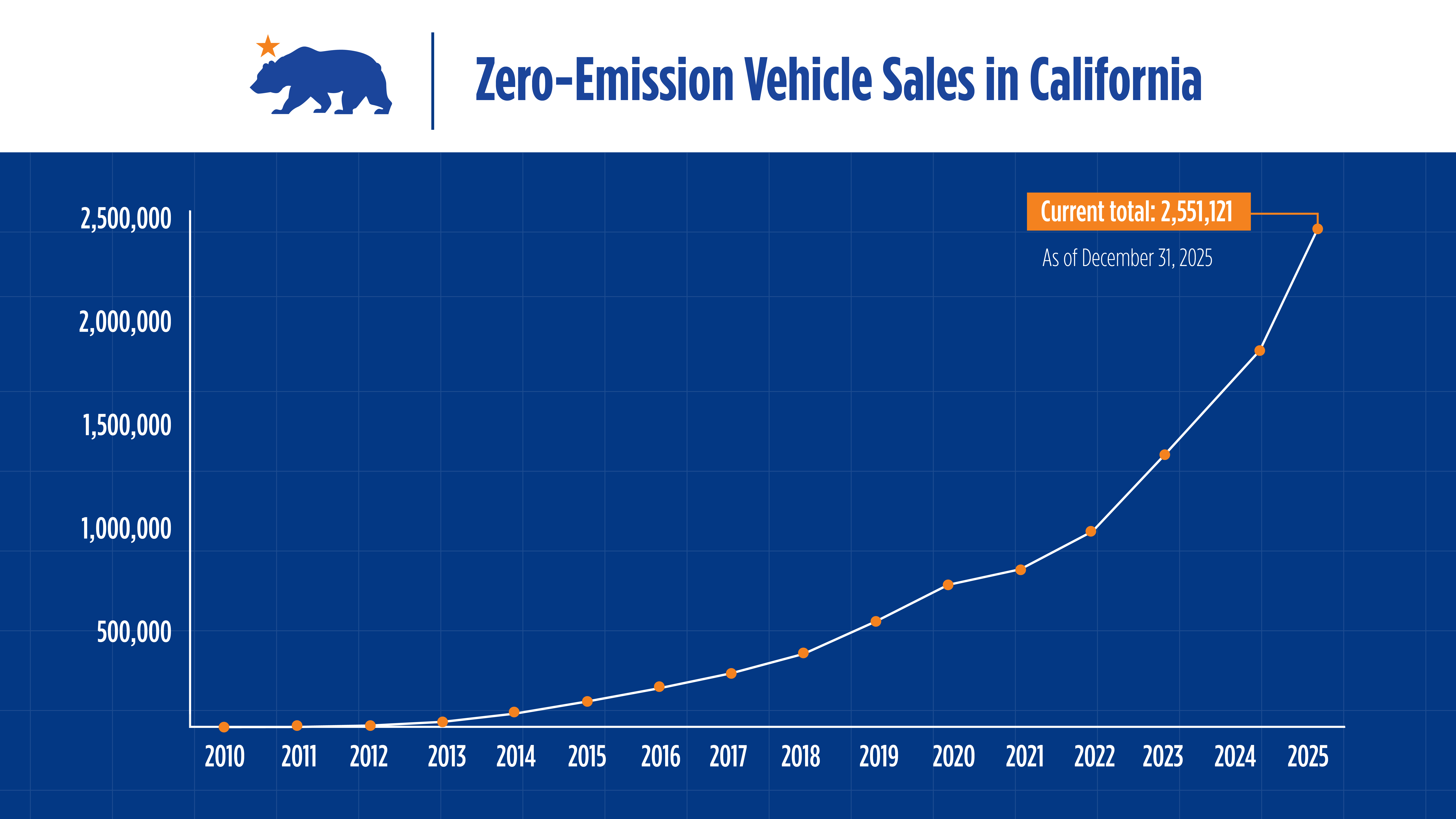
Q4 ZEV Sales Remain Strong Amid the Cancellation of Federal Incentives
During the fourth quarter of 2025, Californians purchased 79,066 new ZEVs, representing 18.9% of new car sales. These sales figures came in the shadow of federal ZEV incentives that ended on September 30, 2025, which resulted in a nationwide decline in ZEV sales. National sales for the fourth quarter dropped to 5.8%, compared with 10.5% in the third quarter, according to Cox Automotive.
California has proven time and time again that smart state policy is the key to accelerating clean transportation and clean energy technology that is essential to our planet’s long-term health and prosperity. As a result of state action, California is a world leader in solar energy and battery storage.
Knowing the importance of jumpstarting innovative clean energy and clean transportation technologies, California is committed to continuing its leadership in promoting zero-emission driving. In Governor Newsom’s preliminary budget announced on January 9, a new $200 million incentive program was proposed to support the market and American auto innovation at a time when companies are facing unprecedented uncertainty due to the federal government’s actions. With federal uncertainty obscuring the road ahead, incentives are a critical part of the state’s strategy to keep ZEVs affordable and accessible for all.
Despite the setbacks, sales were still strong in Q4. With 149 ZEV models available in California in Q4 of 2025, consumers are buoyed by the diversity of options in the ZEV market. Not only do ZEVs reduce air pollution, but they’re also fun and powerful to drive and cost less to maintain compared to gas-powered vehicles. Find the right vehicle for you on Electric For All.
Setting the Standard for American EV Infrastructure
There are now over 200,000 public and shared private EV charging stations throughout the state. Public chargers can be found at grocery stores, park and ride lots, and even gas stations, while shared chargers can be found at apartment complexes, workplaces, doctors’ offices, sports facilities, and other parking areas that may have some level of restricted access. This statewide network of public and shared private chargers is in addition to the estimated 800,000 EV chargers installed in California homes.
ZEV infrastructure progress is not stopping in 2026. In the latest Clean Transportation Program Investment Plan Update, the CEC allocated $98.5 million in light-duty zero-emission vehicle (ZEV) infrastructure funding for fiscal year 2025-2026. While specific funding opportunities are still being ironed out, many funded projects and solicitations are likely to focus on Level 1 and Level 2 charging in locations with longer vehicle dwell times, including at-home charging with a specific focus on multifamily residences.
The CEC is also continuing to study infrastructure needs across the state, with the following planned for release later this year:
- New and ongoing ZEV infrastructure funding opportunities driven by the $98.5 million investment from the Clean Transportation Program.
- The third Electric Vehicle Charging Infrastructure Assessment, as mandated by Assembly Bill (AB) 2127, which will assess California’s EV infrastructure needs to meet demand.
- The next Electric Vehicle Infrastructure Deployment Assessment, as mandated by SB 1000, to assess whether charging infrastructure is disproportionately deployed.
###
About the California Energy Commission
The California Energy Commission is the state's primary energy policy and planning agency. It has seven core responsibilities: advancing state energy policy, encouraging energy efficiency, certifying power plants, investing in energy innovation, developing renewable energy, transforming transportation, and preparing for energy emergencies.
Newsroom
Media Contact
Media and Public Communications Office
MediaOffice@energy.ca.gov
(916) 654-4989