
For Immediate Release: Jan. 13, 2026
WHAT YOU NEED TO KNOW:
The 2025 update of the California Energy Code went into effect Jan. 1, 2026 for new buildings and major renovations. The 2025 code will save Californians almost $5 billion in energy costs over 30 years, reduce greenhouse gas emissions by the equivalent of over half a million homes, and improve indoor air quality.
SACRAMENTO —California’s latest Energy Code update went into effect Jan. 1, 2026, increasing the energy efficiency of new single-family homes, multifamily housing, and non-residential/commercial buildings as well as additions and alterations to existing buildings.
The 2025 code updates will save consumers money and reduce greenhouse gas (GHG) emissions through increased energy efficiency. Part of California’s Title 24 Building Standards Code, the 2025 Energy Code is notable for its encouragement of energy-efficient heat pumps for space and water heating and strategies to shift energy use away from peak demand times. It plays a large role in California’s ongoing effort to decarbonize its buildings, which currently emit 25% of the state’s total GHGs.
These updates will save an estimated $4.8 billion in energy costs over 30 years and reduce GHG emissions by about 4 million metric tons—equivalent to the annual energy consumption of over half a million homes, according to the California Energy Commission (CEC). Furthermore, builders can voluntarily incorporate even higher building efficiency standards through a part of the code known as CALGreen, which was also updated with the 2025 Energy Code.
The Energy Code governs the energy-saving requirements of buildings. The CEC develops and approves new codes every three years to incorporate innovations in technology and to reflect cost and emissions savings for the life of the building. The code development process considers input from the public, builders, and other stakeholders.
“Energy efficiency is the quiet workhorse of the clean energy transition. Efficiency reduces Californians’ bills, improves their health and comfort, and reduces strain on the electricity grid,” said CEC Commissioner Andrew McAllister. “When we build and upgrade homes to use less energy, California families save money, and communities get cleaner air and a more reliable electricity system.”
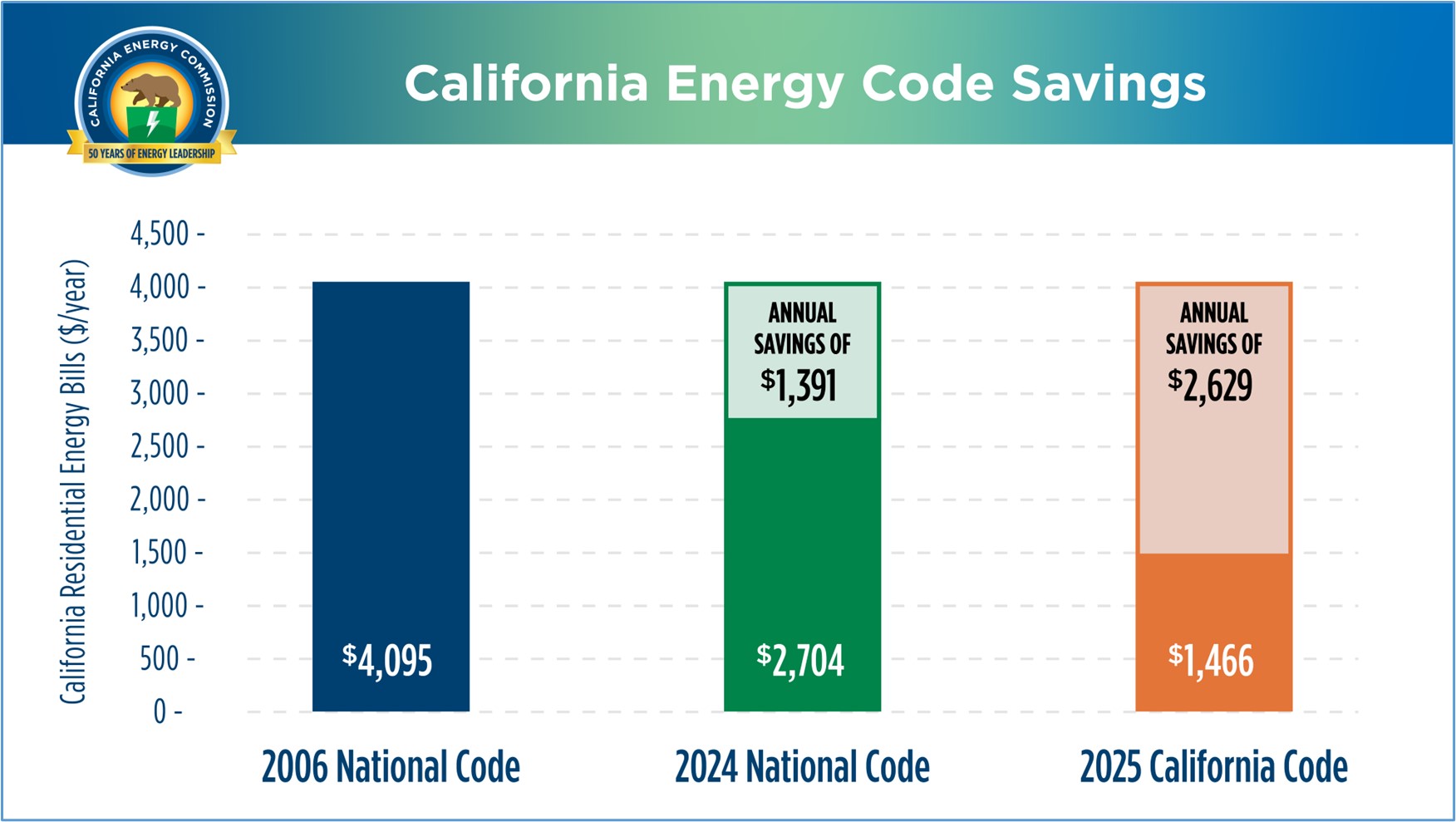
By building homes to the 2025 California Energy Code instead of the latest national standards, Californians will save nearly half on their energy bills. Many new U.S. homes aren’t even built to the latest national model code, making new California homes some of the most efficient in the country. (Note: Total costs and savings for each scenario is for an average California home’s utility cost and savings under different code scenarios.)
What’s new for 2025? These apply to new buildings, as well as major alterations and additions to existing buildings:
For single-family homes:
- Through the establishment of energy use "budgets” for buildings, encourages heat pumps for home heating and cooling air and for water heating.
- Updates HVAC efficiency and controls requirements, for example letting residents automatically take advantage of lower-cost rate periods with smart thermostats that access energy pricing information.
- Increases the efficiency of exterior walls and windows, making homes more comfortable.
For multifamily homes:
- Encourages heat pumps for space heating and cooling through energy use “budgets.” Encourages heat pump water heaters for units with individual water heaters in low-rise buildings of three or fewer habitable floors. (Other multifamily buildings base their energy budgets on a heat pump for space heating, only.)
- Establishes electric-ready requirements to make it easier and cheaper to install clean, electric water heating and cooking appliances if and when a resident chooses to.
- Strengthens ventilation standards to improve indoor air quality.
- Expands electric vehicle charging access through dedicated circuits and parking spaces with chargers.
- Increases building envelope efficiency through measures such as wall and slab edge insulation, to keep residents more comfortable.
For businesses and nonresidential buildings:
- Encourages use of heat pumps for space heating and cooling in select new buildings.
- For alterations only: the 2025 code replaces certain end-of-life rooftop HVACs with high-efficiency systems, including heat pumps, on stores, schools, offices, and libraries.
- Establishes electric-ready requirements for commercial kitchens for easier transition to cleaner electric appliances in the future.
- Updates HVAC efficiency and control standards.
- Increases the building envelope efficiency through improved ceilings, exterior walls, and windows to keep occupants more comfortable.
It should be noted that Executive Order N-29-25 temporarily suspends the 2025 update for projects involving the repair, restoration, demolition, or replacement of residential structures or facilities substantially damaged or destroyed by the 2025 Los Angeles area wildfires. These projects are not required to comply with the solar and battery energy storage requirements but must be solar-ready.
“We are gratified that builders in California will be designing to the 2025 California Energy Code,” said CEC Building Standards Branch Manager Gypsy Achong. “Compliance with this update is the most affordable way to build a resilient and comfortable building for the future. This update does not mandate specific technologies or fuel types. We continued our long-standing tradition of figuring out what energy budget is pragmatically possible and then asking designers to meet that budget. We are delighted that this approach continues to affordably advance our state’s transition to 100% clean energy in buildings.”
California’s National Leadership in Energy Efficiency
In March 2025, California was again ranked first in the nation for its leadership in energy efficiency policy and practice. The State Energy Efficiency Scorecard is released annually by the American Council for an Energy-Efficient Economy, a nonprofit research organization that develops policies to reduce energy waste and combat climate change.
This is the seventh time California has topped the scorecard in 16 years of rankings. In 2025, California received the highest score in all six categories, reflecting its commitment to equitable decarbonization including goals to install heat pumps and make homes more climate-resilient in low-income and disadvantaged communities.
The 2025 Energy Code update builds on this leadership, ensuring California homes and businesses are healthier and more energy efficient in the face of climate change.
California Energy Efficiency at a Glance:
- Californians have saved over $200 billion dollars in energy costs in the past 50 years, thanks to the state’s energy efficiency standards for appliances and buildings. This number is expected to reach $300 billion in total cumulative economic value to the state by 2030.
- California appliance standards have saved Californians more than $11 billion in the past year alone. These savings also result in carbon emission reductions equivalent to 60 gas power plants. The annual electricity bill savings from appliance energy standards in 2024 include (source data extrapolated to present year):
- $4.7 billion in lighting.
- $2 billion in televisions and signage displays.
- $1.64 billion for battery chargers.
- $593 million for computers and $89 million for monitors.
###
About the California Energy Commission
The California Energy Commission is the state's primary energy policy and planning agency. It has seven core responsibilities: advancing state energy policy, encouraging energy efficiency, certifying power plants, investing in energy innovation, developing renewable energy, transforming transportation, and preparing for energy emergencies.
Newsroom
Media Contact
Media and Public Communications Office
MediaOffice@energy.ca.gov
(916) 654-4989