
- Acceptance Testing for Nonresidential and Multifamily Buildings
- Changes in the Energy Code Compliance (ECC) – New Program, Same System
- Plumas Sierra Community Shared Solar Program Approved
- AHAM Bathroom Exhaust Fan Testing and Certification Program Approved
- Executive Director Determination: Dedicated Outdoor Air Systems with Water Loop Heat Pump
- Energy Code Support Center Updates
- 2025 Single-Family HVAC FAQs
- 2025 Single-Family Electric-Ready FAQs
- 2025 Multifamily Electric-Ready FAQs
- 2025 Energy Code Compliance (ECC) Providers Counter Sheet
- 2025 Acceptance Test Technician Certification Providers (ATTCPs) Counter Sheet
- Variable Refrigerant Flow Minimum Efficiency Requirements Guidance
- 2025 Accessory Dwelling Units presentation
- Q&As
- Solar PV & Battery Energy Storage Systems (BESS)
- Ventilated Attic Insulation
Acceptance Testing for Nonresidential and Multifamily Buildings
The Energy Code requires acceptance testing for lighting controls (Section 130.4), mechanical systems (Section 120.5), fenestration (Reference Nonresidential Appendix NA7.4.1.1), and covered processes (Sections 120.6, 140.9) in nonresidential and multifamily buildings. Acceptance testing consists of visual inspection and functional performance testing of installed equipment. Acceptance testing helps ensure that the installed equipment operates as designed and complies with the Energy Code.
Only certified acceptance test technicians (ATTs) may perform required tests for lighting controls and mechanical systems in nonresidential and multifamily buildings. The CEC approves Acceptance Test Technician Certification Providers (ATTCPs) to train, certify, and oversee the technicians and their employers. ATTCPs are responsible for establishing and implementing quality assurance procedures, which include review of a sample of completed compliance forms and shadow audits of ATTs. For more information on the ATTCP program, please see the ATTCP Frequently Asked Questions (FAQs) webpage.
Recent reviews of ATT field test data have revealed that compliance with the acceptance testing requirements is low. Specifically, applicable acceptance tests and forms are not being specified on the respective nonresidential certificate of compliance (NRCC), and, as a result, the applicable acceptance tests and nonresidential certificate of acceptance (NRCA) are not being completed after installation.
The enforcement agency is responsible for enforcing the acceptance testing requirements. Relying on the ATTCP program to ensure the Energy Code requirements are met reduces the time and effort required of enforcement agency staff at plan review and site inspection. At plan review, enforcement agency staff should review the NRCCs which identify the mechanical and lighting control systems acceptance tests that must be performed by a certified ATT. At inspection, the completed NRCAs must be made available to the enforcement agency before the certificate of occupancy can be issued, per Section 10-103(a)4C. The enforcement agency should verify the ATT's certification status on the ATTCP’s website and that the NRCAs are watermarked with the ATTCP logos.
Enforcement agencies may request training from CEC staff on the ATTCP program for lighting controls and mechanical systems.
For questions on the ATTCP program or to request free ATTCP training, please contact the Standards Compliance Branch at SCO@energy.ca.gov. For more information, please visit the ATTCP program webpage.
Acceptance Testing Resources
- Acceptance testing resources are available on the ATTCP webpage under educational resources
- Inspector Field Sheet
- CBECC 2.0 updates to trigger acceptance tests on the NRCCs
Updated 2025 Energy Code acceptance testing resources are available on the Energy Code Support Center under its ATTCP topic webpage.
Changes in the Energy Code Compliance (ECC) – New Program, Same System
The Energy Code Compliance (ECC) Program has replaced the California Home Energy Rating System (HERS) for all past and new residential projects complying with the Energy Code.
Key changes include:
- HERS Providers and HERS Raters are now ECC-Providers and ECC-Raters, respectively.
- Registered compliance documents have not changed in format and layout. Watch for "ECC" in place of "HERS," but only on 2025 Energy Code forms and reports. Previously approved data registries will continue to offer forms from past code cycles and these projects are unaffected by the change.
- All ECC-Raters must be fully trained. Certification requires training on all FV&DT protocols for every residential occupancy type, including both newly constructed and existing buildings.
- Group sampling is only available to new construction projects. Alterations complying with the 2025 Energy Code may not utilize sample groups.
- Quality Assurance (QA) has been reconfigured to enable approachable metrics and now requires on-site audits and data review audits. Most on-site audits remain random and unannounced following a rater's visit, but some are coordinated so that the provider's evaluator can observe the rater's verifications.
Newly added:
- "ECC-Rater Company" and "Independent ECC-Rater" have been defined. Understanding how each operates helps enforcement agencies confirm that the right people are performing the right work. It supports accurate credential checks, reduces the risk of unauthorized testing, and strengthens consistent code enforcement.
- Both must be certified and overseen by an ECC‑Provider.
- Rater Companies
- Can offer multiple compliance services under one organization
- May streamline services on large projects, but enforcement agencies must confirm the credentials of each individual rater involved.
- Independent Raters
- May only perform the services they are individually certified for.
- Whether independent or company‑employed, can sign the Certificate of Verification.
- Offer simpler verification, but one project may require multiple raters
- Annual Rater reports due June 1, 2027; Rater Company activity reports due late March 2027. Reporting includes:
- Services and costs - track now, report later. This feedback shows the value of services.
- Companies must also report employed raters and overall volume of tests and types performed.
- Raters and Rater Companies will need to submit annual activity reports to the CEC, starting in Spring 2027. These reports will include the total and average cost of services charged for each type of field verification and diagnostic test performed by Raters employed by the Rater Company during the prior calendar year, a list of all Raters employed by the Rater Company, the total number of field verifications and diagnostic tests performed by Raters employed by the Rater Company during the prior calendar year, organized by enforcement agency. This data reflects the value and demand for rating services, but also provides enforcement agencies with a clearer picture of how compliance work is being delivered statewide—supporting better oversight, consistent enforcement, and program improvements.
- Project teams must provide two key documents to building or project owners to help verify that required tests and inspections were properly completed and protect consumers by ensuring they know their rights and whom to contact with concerns. They make the compliance process clearer, more accountable, and easier to review—benefits for both departments and project owners alike.
- Consumer Information Form (CIF) gives owners an overview of the Energy Code Compliance (ECC) Program. It explains the roles of ECC‑Raters, Providers, and Rater Companies, and outlines how owners can file complaints
- “Project/Building Owner Report” (POR) identifies who performed the compliance work and summarizes exactly what was done. It includes the rater’s credentials, links to the data registry, the registry numbers for all compliance documents, and an itemized list of services, charges, and pass/fail results.
- ECC Provider responsibilities for managing their provider data registry, as well as oversight of raters and rater companies, have expanded.
Visit the ECC Program Page for other considerations and more details.
Announcements
Plumas Sierra Community Shared Solar Program Approved
The Plumas Sierra Rural Electric Cooperative has been approved per Section 10-115 to establish and administer a community shared solar photovoltaic generation system for newly constructed single-family buildings. The system will serve parts of Lassen, Plumas, and Sierra Counties.
Approved community shared electrical generation and/or battery energy storage systems (BESS) provide an option for newly constructed buildings to fully or partly offset their solar photovoltaic and/or BESS requirements. Upon approval of these systems, approved compliance software will be modified to allow newly constructed single-family building projects served by the system to receive compliance credit for participation in the community system under the performance compliance method.
AHAM Bathroom Exhaust Fan Testing and Certification Program Approved
The CEC has approved the Association of Home Appliance Manufacturers’ (AHAM’s) Verifide® program as an alternative certification directory for bathroom exhaust fans in residential buildings under the 2025 Energy Code.
AHAM had requested that the CEC recognize its AHAM Verifide® program as an additional compliance pathway for certifying bathroom exhaust fans under the 2025 Energy Code. AHAM indicated that its AHAM Verifide® program meets the requirements of ASHRAE 62.2-2022, Section 7.1. The submission included detailed information on program administration, product testing procedures, and laboratory accreditations. With this approval, manufacturers may demonstrate compliance with applicable airflow and sound rating requirements using either the Home Ventilating Institute (HVI) directory or the AHAM Verifide® directory.
Executive Director Determination: Dedicated Outdoor Air Systems with Water Loop Heat Pump
The Executive Director issued a determination regarding the energy use of Dedicated Outdoor Air Systems with Water Loop Heat Pumps (DOAS+WLHP), allowing them to be used as an additional prescriptive compliance option under Section 140.4(a)3. These systems utilize zone-level heat pumps connected through a common hydronic loop, a DOAS for ventilation, cooling towers for heat rejection, and air-to-water heat pumps (AWHPs) for heat addition. DOAS+WLHP systems designed to comply with the Executive Director’s determination must meet the Minimum Requirements listed in the Memorandum of determination.
Energy Code Support Center Updates
Please visit the Energy Code Support Center webpage for resources, including fact sheets, FAQs, guides, presentations, training classes, videos, and links to additional resources. New resources include:
- 2025 Single-Family HVAC FAQs
- 2025 Single-Family Electric-Ready FAQs
- 2025 Multifamily Electric-Ready FAQs
- 2025 Energy Code Compliance (ECC) Providers Counter Sheet
- 2025 Acceptance Test Technician Certification Providers (ATTCPs) Counter Sheet
- Variable Refrigerant Flow Minimum Efficiency Requirements Guidance
- 2025 Accessory Dwelling Units presentation
Q&As
Can single-family building projects use BESS with a cycling capacity of 5 kWh?
Yes. Single-family building projects may use BESS with a cycling capacity of 5 kWh. However, such batteries must meet the minimum requirement for credit as specified in Reference Appendices, Joint Appendix JA12.3.2.2. To receive compliance credit, the CF1R form must note the cycling capacity is 5 kWh for single-family buildings.
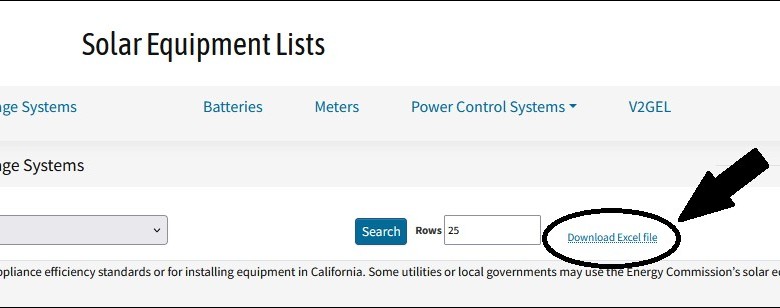
Project teams and enforcement agencies are strongly encouraged to download and review the most current list of BESS that qualify for the compliance credit. Excel files are available on the CEC Solar Equipment Lists webpage by clicking on the downloadable Excel file link (Figure 1).
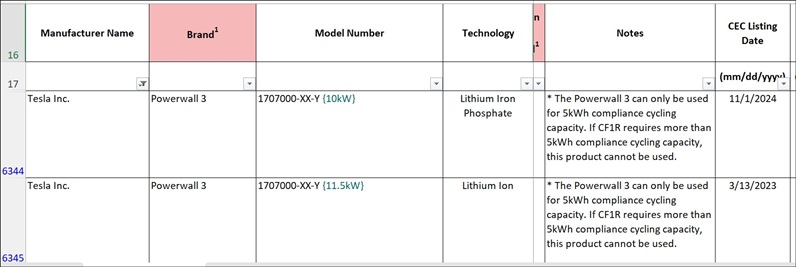
This list will indicate whether a specific BESS qualifies for compliance credit or if they have any special JA12 condition. For example, in the image below, the Note for the Powerwall 3 indicated that the BESS can only be used when the required compliance cycling capacity is 5kWh. Projects requiring compliance cycling capacity greater than 5kWh may not use the Powerwall 3. (Figure 2)
- Is there a discrepancy between California Residential Code, Section R806.3, and the California Energy Code for residential ventilated attics?
- Possibly. For residential ventilated attics, the 2025 California Residential Code (CRC) Section R806.3 requires a minimum 1-inch airspace between the insulation and the roof sheathing, and at the vent location when eave or cornice vents are installed. This is a long-standing requirement intended to mitigate moisture concerns associated with older roofing and insulation practices. The 2025 California Energy Code Sections 150.1(c)1A (for single-family buildings) and 170.2(a)1B (for multifamily buildings), and the quality insulation installation (QII) requirements under Reference Residential Appendix RA3.5 prescriptively require insulation in ventilated attics be installed between the roof rafters and in direct contact with the roof deck. When this requirement was developed, the analysis assumed the use of air-permeable insulation would adequately address moisture-related issues in most California climate zones.
- The CEC advises that when the local enforcement agency has concerns about moisture, and it is not possible to comply with both the Energy Code QII requirement and the CRC ventilation requirement at the same time, the CRC takes precedence and the 1-inch air gap must be provided.
- This advice applies only to ventilated attic designs. The CRC does not require an air gap in unvented attic applications, and the Energy Code’s requirements align with typical unvented attic construction practices.