
For Immediate Release: July 20, 2026
WHAT YOU NEED TO KNOW:
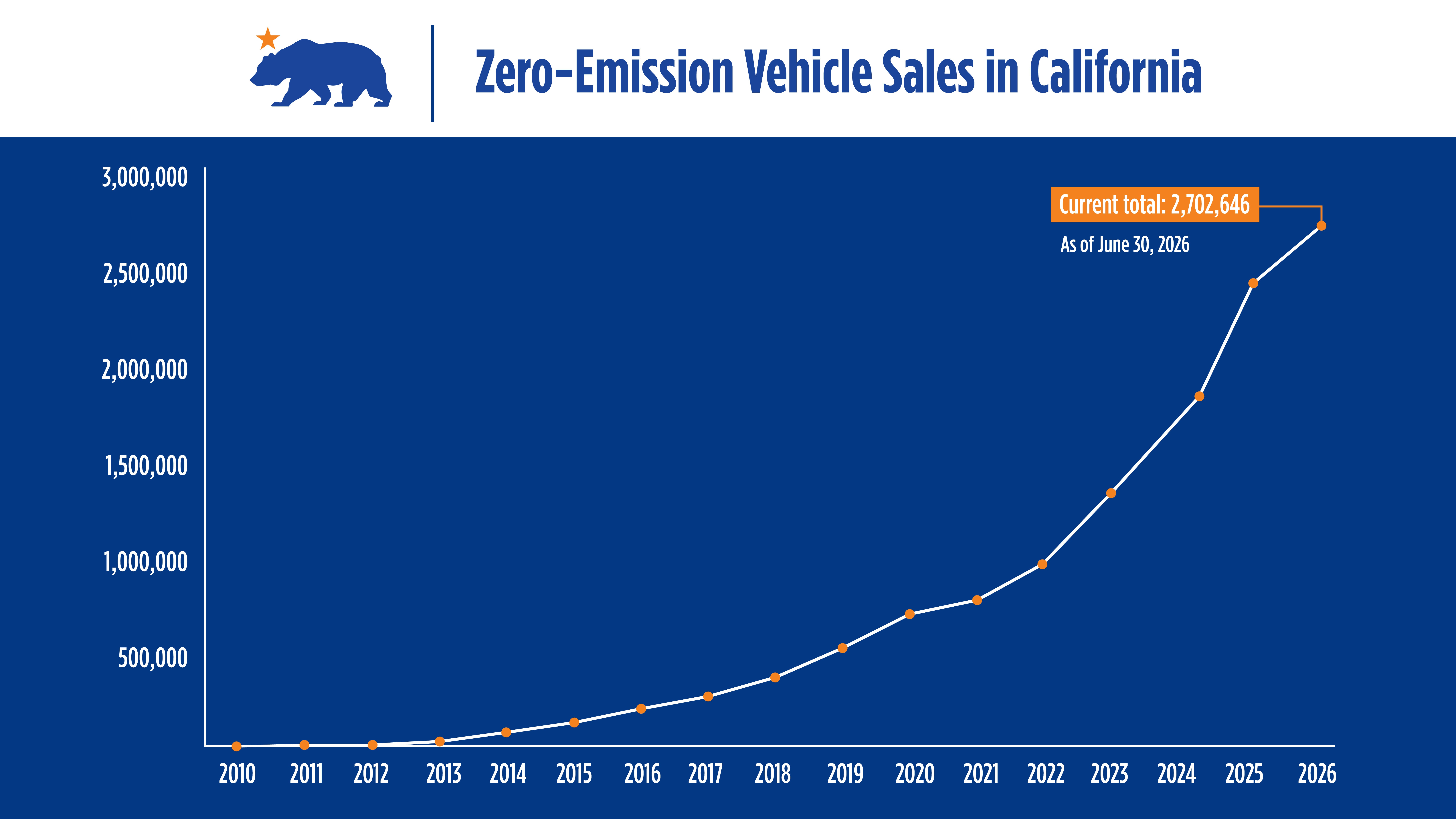
As gasoline prices skyrocketed in the wake of Trump’s war in Iran, new zero-emission vehicle (ZEV) sales increased in the second quarter of 2026, representing 19.1% of new vehicle sales in California, a 3.3 percentage point increase quarter over quarter. California remains the nation’s leader in ZEV purchases and infrastructure.
SACRAMENTO — Today, the California Energy Commission (CEC) announced that during the second quarter of 2026, Californians purchased 86,857 new zero-emission vehicles (ZEVs). This represents 19.1% of new car sales, an increase of 3.3 percentage points compared to the first quarter of 2026. Most new ZEV sales in California are electric vehicles (EVs), representing 16.6% of new car sales compared to 5.8% nationally as gas prices soared across the country.
This recent quarter’s sales represent the highest share of new EV purchases recorded without federal tax credits and are only 2.5 percentage points below the same quarter last year, when the $7,500 federal incentive was still available. In an era of volatile gasoline prices, these sales numbers demonstrate Californians’ continued enthusiasm for ZEVs. And with Governor Gavin Newsom’s new California instant rebate program, MyFirstEV, taking effect next month, these numbers are likely to grow.
“While Donald Trump makes Americans pay the bill for his Iran war at the pump, California is giving families the freedom to choose a cheaper way forward by going electric,” said Governor Newsom. “California’s MyFirstEV instant rebate program is going to put thousands more Californians behind the wheel of a car that can’t be held hostage by greedy oil companies or foreign wars. We built the largest electric car market in America, and we’re not stopping now.”
“This is an exciting time for prospective EV buyers in California,” said CEC Commissioner Nancy Skinner. “There are many affordable new and used EV models available, and the MyFirstEV program will give thousands of Californians the chance to ditch their increasingly expensive gas vehicles. As California continues to rapidly build out a reliable and publicly available fast charging network, there has never been a better time to go electric.
"Nearly 1 in 5 Californians are choosing to go electric because EVs are fun to drive, fast, and cheaper to fuel and maintain,” said California Air Resources Board Chair Lauren Sanchez. "With the state’s new MyFirstEV program, we're making it easier for first-time buyers to make the switch. As federal actions threaten decades of progress, California is committed to protecting public health and delivering cleaner air across the state.”
California sales far exceed the national sales share, which has remained at 5.8% for the last three quarters, according to Cox Automotive.
Helping Californians Go Electric with MyFirstEV
For California families who have been waiting for the right moment to go electric, that moment is coming later this summer. The MyFirstEV program, administered by CARB, will deliver $3,500 off the price of a new electric vehicle right at the dealership. California’s $135.5 million state investment is matched dollar-for-dollar by 13 automakers, delivering a combined $270 million in total savings to California families at the point of sale. Here’s what buyers need to know:
- $3,500 off new electric vehicles with an MSRP up to $50,000
- $1,750 off used electric vehicles sold for up to $25,000
- The rebate is open to any Californian buying their first ZEV
Second Quarter New ZEV Sales See Increase Amid Rising Gas Prices
During the second quarter of 2026, Californians purchased 86,857 new ZEVs, representing 19.1% of new car sales, according to CEC data. Of this total, 75,597 were EVs, 81 were hydrogen fuel-cell vehicles (FCEVs), and 11,179 were plug-in hybrid vehicles (PHEVs).
These vehicles achieve significant reductions in smog and greenhouse gas emissions and, under the CARB Advanced Clean Cars Program, count towards California’s 100% ZEV goal. And while PHEVs include a traditional internal combustion vehicle, average daily driving can be met with electric power.
With 136 ZEV models available in California — including 85 EVs, 50 PHEVs, and 2 FCEVs — consumers have diverse options. Not only do ZEVs reduce air pollution, but they’re also fun and powerful to drive and cost less to maintain. Find the right vehicle for you at ElectricForAll.org.
California EV sales are maintaining strong market share after federal incentives were eliminated on September 30, 2025. California sales far exceed the national sales share, which has remained at 5.8% for the last three quarters, according to Cox Automotive.
Investing in ZEV Infrastructure
California continues to invest in ZEV infrastructure. In the latest Clean Transportation Program Investment Plan Update, the CEC allocated $98.5 million in fiscal year 2025-2026 to support light-duty ZEV infrastructure, including EV charging and hydrogen fueling. Thanks to continued investments, California now has 216,445 publicly available and shared EV charging ports across the state. California also surpassed 20,000 direct-current fast chargers (DCFCs), easing range anxiety for both short trips near home and long-haul travel along California’s major transportation corridors. DCFCs offer substantially faster charging speeds and continued advances in vehicle and charger technology have achieved even faster speeds.
California’s growing number of publicly available EV chargers can be found at locations that are fully publicly accessible, like grocery stores, park-and-ride lots, and even gas stations, whereas shared chargers can be found at apartment complexes, workplaces, doctors’ offices, sports facilities, and other parking areas that may have some level of restricted access. This statewide network of public and shared chargers is in addition to the estimated 800,000 EV chargers installed at residential homes.
The CEC also continues to study EV charging infrastructure needs across the state, with the following planned for release later this year:
- The third Electric Vehicle Charging Infrastructure Assessment, as mandated by Assembly Bill (AB) 2127, which will assess California’s EV infrastructure needs to meet demand.
- The next Electric Vehicle Infrastructure Deployment Assessment, as mandated by Senate Bill 1000, to assess whether charging infrastructure is disproportionately deployed, was published in February.
- The first EV charging reliability report, as mandated by the new EV Charger Reliability Reporting and Standards Regulations.
###
About the California Energy Commission
The California Energy Commission is the state's primary energy policy and planning agency, leading the state to a 100 percent clean energy future for all. It has seven core responsibilities: advancing state energy policy, encouraging energy efficiency, certifying power plants, investing in energy innovation, developing renewable energy, transforming transportation, and preparing for energy emergencies.
Newsroom
Media Contact
Media and Public Communications Office
MediaOffice@energy.ca.gov
(916) 654-4989