
For Immediate Release: October 16, 2026
WHAT YOU NEED TO KNOW:
California remains the nation’s leader in new electric vehicle purchases and charger deployment. New EV sales maintain a steady market share in the third quarter of 2026, and the state’s EV charger network continues expanding.
SACRAMENTO — Today the California Energy Commission (CEC) announced that 19.1% of new car sales statewide during the third quarter of 2026 were zero-emission vehicles (ZEVs). The vast majority of these sales were fully electric vehicles (EVs). Here in the Golden State, new EV sales were 16.3% of total new car sales compared to 6.4% nationally.
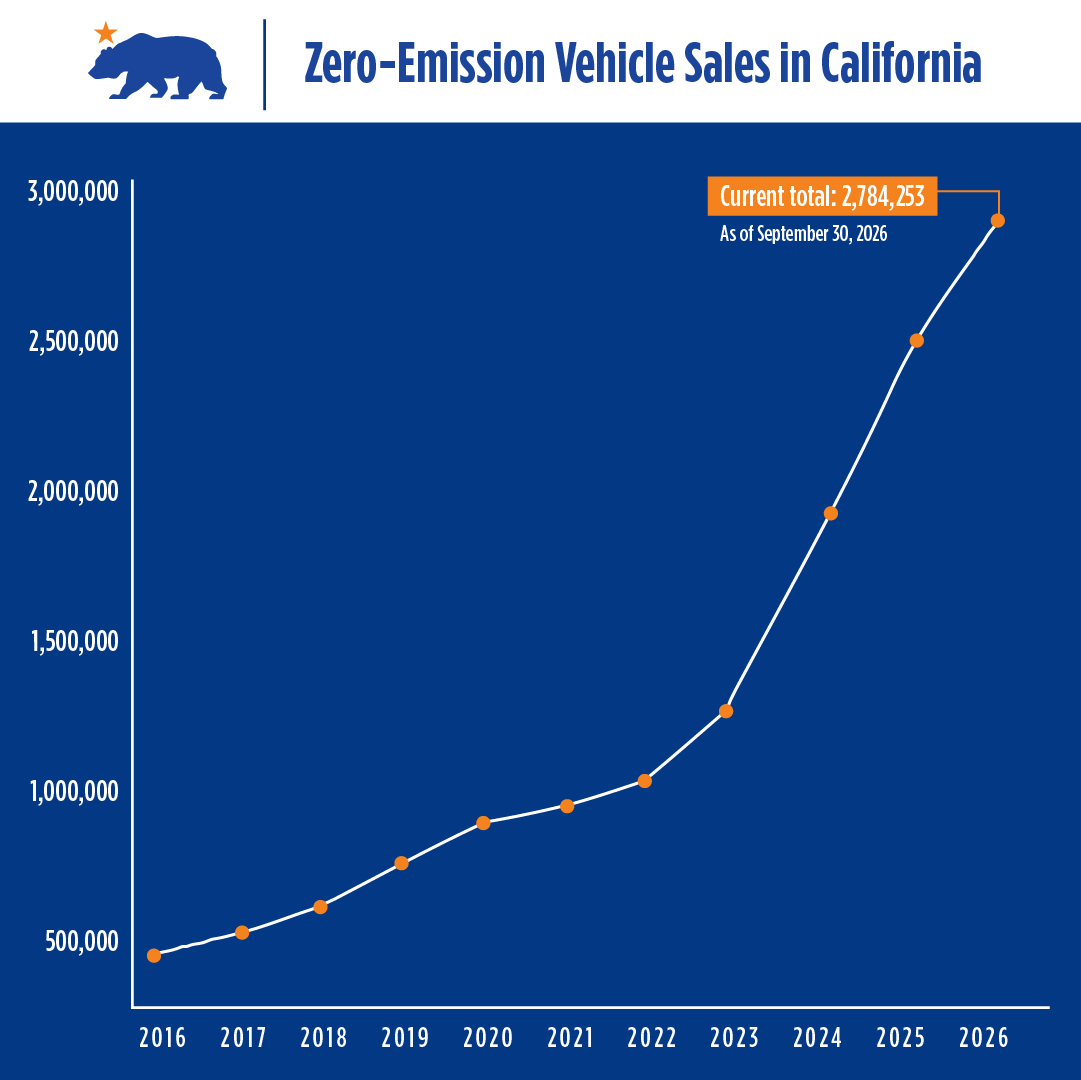
Since Governor Gavin Newsom took office in 2019, cumulative new ZEV sales in California have grown more than 300%. Through effective clean transportation policy and electric vehicle incentives, including the new MyFirstEV program, California remains the nation’s leader in EV purchases and infrastructure.
“Twelve thousand Californians bought their first electric car and said goodbye to the gas pump. That’s nearly twelve thousand drivers who no longer pay the price of Donald Trump’s reckless Iran war every time they fill up,” said Governor Newsom. "This is what affordability and economic security look like: money back in families’ pockets, good-paying jobs here at home, and an America that’s done letting foreign wars and unstable global oil markets set the price of getting to work. California is just getting started.”
“Despite the Trump administration's continued attack on clean vehicles, California drivers continue to go electric, choosing EVs for a great driving experience and no more trips to the gas station,” said CEC Commissioner Nancy Skinner. “And MyFirstEV, Governor Newsom’s EV purchase incentive program, is a great opportunity for drivers looking to join the trend and take advantage of California’s extensive network of publicly accessible EV charging infrastructure.”
“California is full speed ahead. We’re cutting harmful vehicle pollution, delivering cleaner air, and building momentum — and the early success of MyFirstEV is supercharging that progress,” said California Air Resources Board Chair Lauren Sanchez. “Despite federal interference and attempts to turn back the clock, the global market is racing forward, and California will continue to lead.”
It’s Time for Californians to Go Electric with MyFirstEV
For California families waiting for the right moment to go electric, the MyFirstEV program makes EV ownership more affordable. Since launching in August 2026, the incentive program has helped put 12,000 new clean cars on the road. Administered by the California Air Resources Board, the program delivers $3,500 off the price of a new electric vehicle right at the dealership. California’s $135.5 million state investment is matched dollar-for-dollar by 13 automakers, delivering a combined $270 million in total savings to California families at the point of sale. Here’s what buyers need to know:
- $3,500 off new electric vehicles with an MSRP up to $50,000
- $1,750 off used electric vehicles sold for up to $25,000
- The rebate is open to any Californian buying their first EV
Third Quarter ZEV Market Share Remains Steady
The third quarter is typically one of the strongest sales periods of the year, but increased interest rates and low consumer confidence have tempered overall sales of new light-duty vehicles nationwide. The purchase of new EVs in California mirrored the strong performance of the second quarter, while used EV sales are reaching record levels nationally, according to data from Cox Automotive.
During the third quarter of 2026, Californians purchased 80,392 new ZEVs, representing 19.1% of new car sales, according to CEC data. Of this total, the vast majority, 68,811, were EVs, 87 were hydrogen fuel-cell electric vehicles (FCEVs), and 11,494 were plug-in hybrid electric vehicles (PHEVs).
ZEVs achieve significant reductions in smog and greenhouse gas emissions and, under the CARB Advanced Clean Cars Program, count towards California’s 100% ZEV goal. And while PHEVs include a traditional internal combustion vehicle, average daily driving can be met with electric power.
With 145 ZEV models available in California — including 91 EVs, 52 PHEVs, and 2 FCEVs — consumers have diverse options. Not only do ZEVs reduce air pollution, but they’re also fun and powerful to drive and cost less to maintain. Find the right vehicle for you at ElectricForAll.org.
EV Charging Access Continues to Expand Across California
The CEC also announced today that there are now 224,438 EV charging ports at public and limited access sites throughout the state as of June 30, 2026. Since the CEC started tracking charging ports in 2021, total public and limited access ports have increased by 186%, and direct current fast charger (DCFC) ports have increased by 221%.
These charging ports can be found at fully public locations such as grocery stores, shopping centers, gas stations, and community centers, as well as sites with some limitations to access like doctor’s offices, workplaces, and multifamily residences. This statewide network of public and limited access chargers is in addition to the estimated 1,179,497 EV chargers installed in residential homes of one to four units. A growing number, about 23,000, of publicly accessible chargers are DCFCs, which can deliver almost a full charge in 15 to 45 minutes, depending on the car and charger.
With gas prices skyrocketing, charging access expanding, and the MyFirstEV incentive underway, there has never been a better time for Californians to ditch gas engines for an EV.
CEC Releases Updated EV Charger Assessment
The CEC today also released the third Electric Vehicle Charging Infrastructure Assessment, as mandated by Assembly Bill (AB) 2127, which estimates California’s EV infrastructure needs.
With gains in EV range, battery capacity, the growth of available DCFCs, and chargers installed at homes, the CEC’s projections for California’s charging needs in 2030 have been revised. To support an expected 6.8 million EVs in 2030, California will need 478,000 charging ports at publicly accessible locations and locations like workplaces and multifamily housing. With 224,438 currently installed, the state is almost halfway to its estimated 2030 charging need.
To meet the growing demand for EV infrastructure, the state and the CEC continue to invest in light-duty EV infrastructure, focusing on fast charging and at-home or near-home charging, especially at multifamily properties. In addition to the state’s investments, the state is collaborating with private sector partners who are installing new EV charging infrastructure and planning for significant expansion throughout the state.
###
About the California Energy Commission
The California Energy Commission is the state's primary energy policy and planning agency, leading the state to a 100 percent clean energy future for all. It has seven core responsibilities: advancing state energy policy, encouraging energy efficiency, certifying power plants, investing in energy innovation, developing renewable energy, transforming transportation, and preparing for energy emergencies.
Newsroom
Media Contact
Media and Public Communications Office
MediaOffice@energy.ca.gov
(916) 654-4989