
The conflict in Iran, starting on February 28, 2026, has disrupted shipping traffic in the Strait of Hormuz and removed significant oil and product supply from the international market. For the first few months of the conflict, crude oil prices rose sharply, impacting consumers around the world with high gas prices and increases in the cost of goods and air travel.
As the Iran War continues and new global events shift supply dynamics, prices for refined products like gasoline, diesel, and jet fuel remain high.
The following frequently asked questions (FAQ) provide answers to several questions about how gas prices in California and beyond are changing as a result of the war in Iran and other global events.
We compiled this FAQ in June 2026 and endeavor to update content, as needed, with a note indicating when the edit was made. If no date is indicated, the content remains current and accurate. Contact mediaoffice@energy.ca.gov if you have questions.
Click on the boxes below to open and read the answer to each question.
January 2026: California fuel market opens year on stable footing
Retail gasoline prices were in line with prior-year prices. California refiners were preparing for the seasonal transition to summer-blend fuel.
Early February 2026: Summer blend transition and refinery outages
As refiners switched from winter to summer blend gasoline — required in California each year to reduce evaporative emissions from tailpipes and combat smog — they emptied storage tanks and refilled with the new formulation. This predictable seasonal process, along with planned and unplanned refinery outages, tightened supply and elevated retail prices at the beginning of February, independent of geopolitical factors.
February 28, 2026: Iran Conflict begins - Strait of Hormuz threatened
The Iran conflict commenced, and shipping through the Strait of Hormuz was immediately curtailed. Prior to the conflict, in 2025, approximately 17% of California's internationally sourced crude oil transited the Strait. At this time, California had a healthy supply of gasoline, providing initial buffer time for industry and regulators to assess and respond.
March 2026: Global crude markets add risk premium; CEC activates response team
An immediate risk premium was added to crude prices. A risk premium is an additional cost that reflects risk of future supply disruption. The CEC mobilized in-house experts to monitor the situation daily. The Division of Petroleum Market Oversight (DPMO) also stepped up its daily market monitoring and issued an enforcement bulletin and consumer advisory.
March - April 2026: Alternative routes and supply sources established
The market begins adapting. California importers and refiners sourced additional crude from Latin America, Canada, and other non-conflict regions. Alternative shipping routes around the Strait opened, which further mitigated the impacts of the disruption.
April - May 2026: Prices continue rising as crude premium persists
Elevated crude prices, driven by sustained geopolitical risk premiums, continued to increase California’s gas prices.
May 22, 2026 - Present: Continuous monitoring; supply flowing
Gasoline and crude continue flowing to California through local production, refining, and alternative supply routes. The CEC maintains daily demand-supply balance assessments, refinery production tracking, and close engagement with refiners, the Independent Consumer Fuels Advisory Committee, Western States Petroleum Association, and academic partners at UC Davis and UC Berkeley. DPMO continues its daily market monitoring and oversight work.
JUNE 17 – Early July, 2026: Strait reopens and gas prices fall
The United States reached a ceasefire agreement with Iran and conditions to open the Strait of Hormuz. Prices of crude immediately fell and prices at the pump began their descent, though risk premium remains.
Early July – present: Ceasefire ends, global dynamics shift
Tensions escalate between the U.S. and Iran. The U.S. begins air strikes on July 8, effectively ending the ceasefire. Shipping out of the Strait of Hormuz quickly curtailed.
Ukraine’s drone strikes on the largest Russian refinery take more production offline, further changing global dynamics.
Updated August 26, 2026
The Strait of Hormuz is a narrow waterway between Iran and Oman connecting the Persian Gulf to the open ocean. Before the Iran conflict started February 28, 2026, roughly 20% of the world's daily oil supply transited this chokepoint. Prior to the start of the war, California sourced approximately 17% of its total crude oil (which is 29% of its internationally imported crude) via the Strait.
Like the rest of the world, California gas prices rose sharply as a direct result of the war in Iran, which restricted flow of about 20% of the world’s crude oil supply through the Strait of Hormuz – a narrow and vital shipping waterway carrying Middle Eastern oil – since February 28.
Crude oil prices are influenced by a combination of complex factors including global supply and demand. Prices at the pump have gone up in every state, including states that produce oil and states that have zero refineries — that's because oil, whether domestically or internationally sourced, is driven by global prices.
In the weeks after the invasion, sources of crude oil and shipping routes for crude shifted and the market adjusted to the Strait’s effective closure. However, continued uncertainty and volatility in the global market added a geopolitical risk premium — an additional cost that reflects risk of future supply disruption — to the price of crude.
While prices at the pump have eased some, consumers in California and around the world will continue to feel the impact of the risk premium as long as geopolitical uncertainty persists.
The price of global crude oil is typically the leading driver of the cost of refined products. While the Iran war continues to be a major driver of elevated global oil and gas prices, additional global dynamics and disruptions to production and shipping are affecting prices.
China and India are buying less crude, which is softening the price of crude oil. The global market is viewing this as a structural change rather than temporary. China’s demand for fossil fuel has decreased more rapidly than expected – it is estimated to be down ~6% annually, compared to prior expectations of ~2%. This is due in large part to China’s rapid electrification of its transportation sector. EVs now account for 63% of new vehicle sales in China. China’s reduced crude purchases have created a buffer in the global market, preventing sharper crude price increases.
Meanwhile, refinery outages across Asia, Europe, Russia, and parts of the U.S. have tightened the supply of refined product. Major drone attacks on Russian refineries in early August have turned Russia into a net importer of refined products instead of a net exporter. Meanwhile, maintenance at other global refineries is also shrinking global supply. As a result, global retail prices for gasoline and diesel are high even as crude benchmarks have dropped. This dynamic has created a temporary crude-market disconnect.
As production remains tight and global inventories remain below five-year averages, national retail prices are likely to stay elevated even as crude prices soften yet remain volatile. Now, consumers face pressure from both elevated crude oil prices and constrained global supplies of refined products.
Updated August 26, 2026
Brent crude is the global benchmark price for oil, established daily on international commodity markets. Because crude oil is globally traded, supply disruptions anywhere — including the Strait of Hormuz — affect the Brent price. California refiners purchase crude on these global markets, so a Brent increase flows directly into what refiners pay for raw material and ultimately into retail gasoline prices. Every $10/barrel increase in crude translates to a roughly 24 cent/gallon increase at the pump, which is why prices increased in Texas, Oklahoma, and every oil-producing state in America.
Filling up the tank in California costs more on average than other parts of the United States due to 1) the isolated nature of the state’s transportation fuels market, 2) a special gasoline blend that reduces air pollution, 3) environmental program fees, and 4) local and state taxes (though most places have some state and/or local taxes). See a breakdown of California costs. When looking at the breakdown of costs for gasoline, it should be noted that refining margin, distribution margin, crude oil cost, federal excise tax, state excise tax, and state/local sales tax are costs that everyone in every state pays — though the amounts vary across each state. State taxes on California gasoline remain relatively stable, annually adjusted to inflation every July, and are reinvested in California to fund road repairs, highway maintenance, bridge safety, public transit, and bicycle and pedestrian projects.
About 7-10% of California’s total cost of gasoline supports California-specific programs aimed at clean air and climate resilience initiatives. These fees include: the Low Carbon Fuel Standard (18 cents or ~3%) and Cap and Invest (23 cents or ~4%). These programs have successfully reduced tailpipe emissions that impact public health. And these programs are vital to stemming the impacts of climate change, including costly wildfires, extreme heat, and flooding.
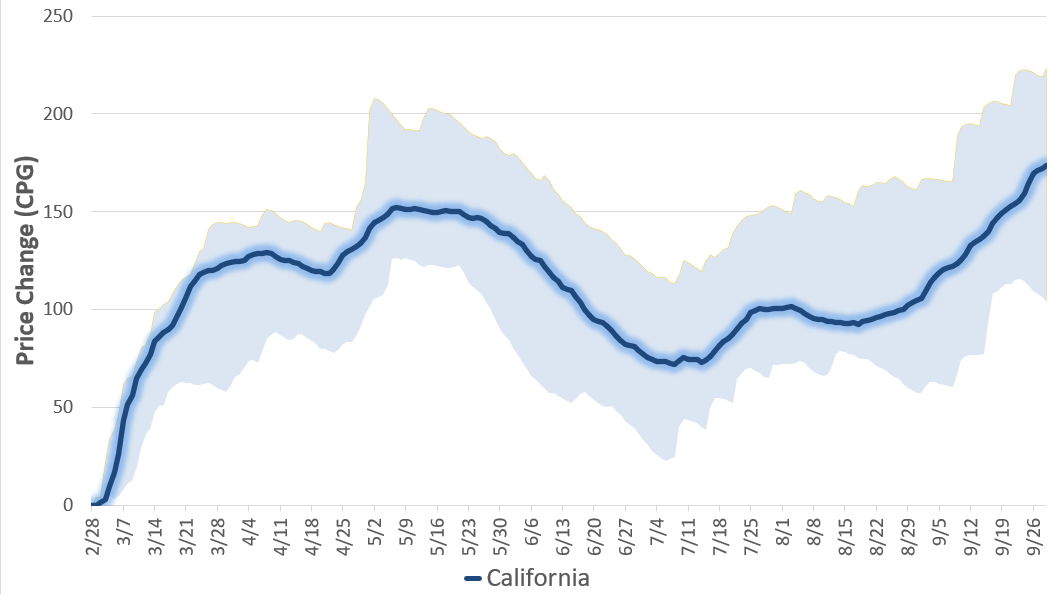
No. This chart shows the increase in gas prices in California (blue line) and the national range of increases from across all states (light blue area) since the beginning of the Iran War. What we see is that the increase in California gas prices is in line with what is happening across the nation. CEC will update this chart weekly.
Updated September 29, 2026
No. The CEC is in close communication with all in-state refiners about transportation fuels supply during this volatile period of supply contraction due to the effective closing of the Strait of Hormuz, through which one-fifth of the world’s oil supply passes. In-state refiners are sourcing imported crude from alternative sources to offset the impact of lost Middle East cargoes.
California’s gasoline needs are being met through a combination of refinery production, inventories, and imports from various sources, and the state is tracking conditions in real time to support fuel market stability.
The CEC can reliably forecast supply for the next six weeks, and we have sufficient supply to meet demand under normal operating conditions, assuming no major unplanned outages. The CEC remains cautiously optimistic about the supply forecast beyond the six-week window.
Given the highly dynamic and fluid nature of the current global oil disruption, six weeks reflects the outer limit of what can be reliably forecasted. Not unlike weather forecasting, there is a finite window of forecasting based on available data and its reliability.
California continues to receive crude oil and gasoline imports from both domestic and global sources. Most transportation fuels are refined in-state. Domestic imports of fuel, including gasoline, are arriving from the Pacific Northwest, U.S. Gulf Coast, and East Coast. Internationally, California imports fuel from India, United Kingdom, and South Korea. California refiners continue to receive crude oil from California, Alaska, Canada, South America, and other regions. For more information, see sources of crude to California refiners and foreign sources of crude to California refiners.
On March 17, 2026, the Department of Homeland Security issued a Jones Act waiver to support domestic port‑to‑port shipments of U.S.-flagged, U.S.-owned, and U.S.-crewed vessels. For California—isolated from the national refining system due to lack of pipeline links to the Gulf Coast—the waiver allows cargo ships from the Gulf Coast to reach California faster. The waiver applies only to specific commodities—gasoline, jet fuel, crude oil, naphtha, LNG, soybean oil, and fertilizers—and has since been extended twice.
The waiver has strengthened short-term supply security in California by expanding routing choices and supplementing foreign imports with domestic imports.
Updated August 26, 2026
California has maintained a healthy inventory position since the conflict started. The inventories shown on CEC’s Weekly Fuels Watch only show inventory at refinery facilities, but California holds more than double that amount in terminals throughout the state. PADD-5 inventories are one indicator of healthy storage. PADD 5 gasoline stocks were at 10-year historical lows mid-May to early June but then climbed to typical summer levels. PADD-5 and California are uniquely situated with strong inventories at this time. Nationally, inventories are down as a result of global shortages. The U.S. Gulf Coast is filling the void for gasoline and diesel demand and exporting these products globally.
Updated August 26, 2026
PADD-5 (Petroleum Administration for Defense District 5) covers the western United States: California, Oregon, Washington, Nevada, and Alaska. Because the West Coast fuel market is largely isolated from the rest of the U.S. pipeline network, PADD-5 regional inventory levels are a critical indicator of local supply conditions.
The duration of supply and price impacts depends primarily on the trajectory of the Iran conflict — particularly whether the Strait of Hormuz remains disrupted to commercial shipping. California's diversified supply base and healthy initial inventory position have absorbed much of the immediate shock. Alternative routes and sources are active.
The CEC regularly assesses and reports out on the gross gasoline refining margin (GGRM) of refiners in California, as required by SB 1322. The GGRM measures wholesale gasoline revenue above crude-oil costs but does not account for refinery operating expenses and other costs.
Current industry gross margins based on the latest data submitted to the CEC are within the range of prior years.
As an independent division of the CEC, the Division of Petroleum Market Oversight is responsible for flagging market structure or design flaws that harm consumers, including matters that may be investigated or referred to for prosecution (such as criminal price gouging or market manipulation).
Updated August 26, 2026
On March 19, 2026, the Division of Petroleum Market Oversight (DPMO) issued an enforcement bulletin and consumer advisory notifying market participants that it was closely monitoring the refining, wholesale, and retail market segments to ensure that firms do not opportunistically raise prices in a manner that is disproportionate to changes in their own input costs. DPMO also encouraged consumers to shop around for gasoline, noting that all gasoline (including branded gasoline) meets California gasoline specifications, including additive requirements.
On June 12, DPMO issued a market update amid rising gas prices due to the Iran conflict. They found that increases in California have been consistent with price increases in the rest of the U.S.; however, this conflict has emphasized the unique and growing difference between branded and unbranded retail gas prices in California.
When DPMO identifies instances of pricing that appear to be excessive and disproportionate to increases in those sellers’ costs, their investigative team reaches out through written correspondence and interviews to determine the facts around those sellers’ pricing, which is the essential first step in the investigative process. Since the launch of the war with Iran, they have contacted a number of station owners that meet targeted criteria for oversight attention. This work is ongoing. See the latest market updates from DPMO on our website.
Every state pays some amount of tax on its gasoline. Taxes on California gasoline remain stable, indexed to inflation (updated annually on July 1), and are reinvested in California to fund necessary road repairs, highway maintenance, bridge safety, public transit, bicycle and pedestrian projects. The federal gas tax, on the other hand, is a fixed cost, $0.18, that hasn’t been increased since 1993. As the purchasing power of the federal gas tax has declined over time, state and local taxes must fill the gap in federal transportation revenue.
Suspending the gas tax may sound like it would offer short-term relief, but it could also cause longer-term impacts to drivers by disrupting current and planned transportation and safety projects. Gas station owners are not required to pass any tax reduction on to consumers and may choose not to. Studies have found that tax reductions are not fully passed through to consumers during times of high retail fuel prices or supply chain constraints (Tsvetanov 2024, Marion and Muehlegger 2011).
Californians have historically suffered from some of the worst air pollution in the nation. Voters have repeatedly passed laws to curtail impacts from the leading cause of that pollution – the transportation sector – through taxes and programs to improve air quality. Our unique blend of gasoline, known as CARBOB, burns cleaner, thereby reducing air pollution, while also cleaning the car’s engine.
Before the weather heats up in California, in-state refiners transition to the state’s summer blend of gasoline, which burns cleaner than what the state uses in the winter. Warmer weather causes gas pollutants to form more ozone, a major contributor to smog. California’s summer blend minimizes the formation of unhealthy smog.
The cost to make California’s summer blend of gasoline is higher than its winter blend. When the fuel transition begins, starting in February or March, supply tightens a bit as refiners wind down winter supply and commence summer blend production. The tightening of supply can exert some upward pressure on prices and also briefly elevate refiner margins, which tend to rise when supply contracts.
Senate Bill 237, signed by Governor Newsom in September 2025, authorizes the Governor, in consultation with the California Air Resources Board (CARB) and CEC, to suspend California’s seasonal gasoline blend requirements for a limited time if determined necessary to protect consumers from price spikes and unlikely to yield unintended consequences. The bill also directs the CEC, in coordination with CARB, to evaluate alternative fuel specifications and a westwide gasoline specification as part of the next Transportation Fuels Assessment.
At this time, the CEC doesn’t believe that suspending the summer blend would offer a meaningful supply boost that would lower prices enough to justify the negative air quality and health impacts.
Passed in 2023, Senate Bill X1-2 (SB X1-2) provided the CEC with a set of tools to bring more transparency to the California transportation fuels market and allowed the CEC to set a maximum gross gasoline refining margin (GGRM) and a penalty for refiners that exceed it, if the CEC found that the potential consumer benefits of a maximum GGRM outweighed the potential consumer costs. Assembly Bill X2-1 (AB X2-1) was passed in 2024 and expanded the state’s petroleum market oversight framework by giving the CEC authority to regulate refinery fuel inventories and maintenance planning to reduce price spikes. That legislation allows the CEC to require refiners to maintain minimum fuel inventories and develop resupply plans during refinery maintenance or outages.
In August of 2025, after conducting analysis and public outreach, the CEC voted to deprioritize the GGRM and penalty in favor of a holistic evaluation of supply stabilization strategies, including the AB X2-1 tools. The CEC kicked off an informational proceeding concerning mid-transition petroleum supply stabilization strategies in September 2025. A Transportation Fuels Reliability Workshop with a focus on resupply for planned refinery maintenance was held in June. The impacts and potential framework for minimum inventory are currently being assessed.
With the new transparency into the petroleum industry granted by these special session laws, and based on California refinery events and global events, CEC is gaining valuable perspective on forces shaping the market and what can and cannot be mitigated for.
Unfortunately, very little can help soften the blow of a global supply disruption of this proportion. Many experts agree that minimum inventory and resupply efforts are intended to support anticipated local outages, not global supply disruptions and historic price volatility.
That doesn’t mean that California can’t be proactive for future unplanned events. Efforts to increase storage, pipelines, and port capacity are worthy endeavors to build resilience into the system.
Long term, it is widely believed that accelerating electrification of the transportation sector is the best insurance against future price spikes.
It is true that utilizing California crude oil can make the state less reliant on foreign crude oil imports. However, it takes time to open new wells, procure drilling equipment, and begin operations – it takes months, not days.
Last year, the Governor signed SB 237 to increase permit issuance for oil production in Kern County. Since January 1st, Kern County has issued 385 permits for various types of well work, and CalGEM has issued 138 permits to drill new oil and gas wells, which are all under strengthened safety requirements and enhanced protections to safeguard communities from oil and gas operations.
Despite the current global oil disruption, increasing supply in California will not necessarily lower gas prices, because oil trades at a worldwide price. American crude sells at the global price, which has been sharply elevated by the conflict. Similarly, restarting offshore drilling and the Sable pipeline will have minimal impact on California gas prices.
Demand for gasoline is declining. California’s peak demand for transportation fossil fuels occurred in 2004. In 2024, gasoline demand was down 16 percent, resulting in significant reductions in air pollution.
The pandemic significantly accelerated a decline in demand. Furthermore, California’s promotion of zero-emission vehicles is working. With more than 2.5 million new zero-emission vehicles sold in California, the transition to cleaner transportation is inevitable. Refining petroleum is also an expensive endeavor, requiring frequent maintenance on massive infrastructure to ensure worker safety. Over the past couple of decades, refineries across the state have closed or converted their operations based on business priorities – a trend that is playing out globally.
The CEC is working closely with refiners, communities, labor groups, state and local agencies, and other stakeholders to advance a clean transportation transition strategy that protects consumers, workers, and communities while still helping ensure that refiners continue to see the value in serving the California market.
The CEC and its partners are diligently trying to strike a balance to ensure that Californians have access to safe, reliable, affordable transportation fuels as the state transitions to a cleaner future.
Yes. The CEC monitors inventories, refinery operations, imports, distribution conditions, and price signals, and coordinates with state and industry partners as needed. Aggregated data, including in-state refinery production and a survey of in-state inventory, can be found on the Weekly Fuels Watch webpage.
The CEC works closely with the California Governor’s Office of Emergency Services (CalOES) and other core state partners through the Emergency Fuels Working Group and Fuels Task Force. CalOES is the primary agency that responds to California emergencies.
As part of the energy security planning, preparedness, and response activities outlined in the 2025 California Energy Security Plan, CEC staff coordinate closely with the U.S. Department of Energy’s Office of Cybersecurity, Energy Security, and Emergency Response through various programs.
CEC staff also actively participate in the National Association of State Energy Officials (NASEO) Energy Security Committee, supporting national collaboration on state energy emergency planning. And we coordinate with NASEO Regional Petroleum Response Collaboratives to strengthen regional catastrophic fuel planning and response.